
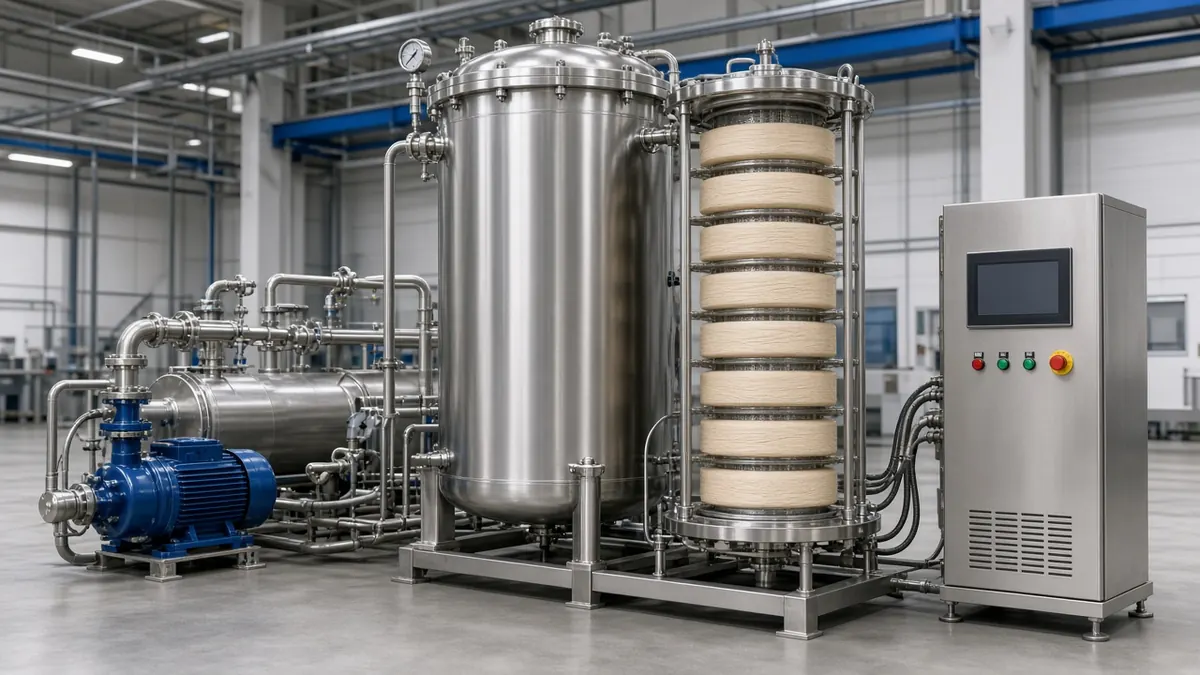
What a package dyeing machine does
Here, package means a package of yarn: a cone or a cheese, not shipping packaging. The yarn is wound on perforated tubes and stacked on spindles. The carrier goes into a sealed vessel, and a pump pushes the dye liquor through the yarn from the inside out and then back from the outside in.
It dyes the yarn, not the fabric. The dyed yarn then goes to weaving or knitting. Mills choose it when they want color fixed before the cloth is made, for stripes, checks, melange effects and knitwear.
Yarns it suits
Cotton, polyester, blends, wool, acrylic and linen yarn. With a different carrier the same vessel can also take hanks, slivers and loose fibre. Polyester needs a high-temperature machine for disperse dyes.
The weak point is the winding. A package wound too hard or unevenly dyes unevenly, whatever the machine does. Check the winding density with your winding department before you blame the dyeing.
Typical data for package dyeing machines
| Item | Typical range | Note |
|---|---|---|
| Liquor ratio | About 1:4 to 1:10 | Lower for newer designs; depends on carrier and load |
| Max. working temperature | About 135 °C (design 140 °C) | High-temperature type for polyester |
| Design pressure | About 0.44 MPa | High-temperature type |
| Standard cone | About 165 mm diameter, 160 to 171 mm high | About 1 kg of yarn per cone |
| Batch size | From 1 to 3 cones (sample) to 2,000 cones or more | Production sizes in the range of hundreds to thousands of kg |
| Liquor-contact parts | Stainless steel | Grade (for example 316L) set per order |
| Flow direction | In to out, out to in, or alternating | Alternating reduces side-to-side difference |
Typical ranges from published industry data. Capacity, pump and control for your order are set in the quotation.
How to choose
Start with batch size in kilograms. Most mills run one or two standard sizes and keep a small sample machine next to them.
Then yarn type. Polyester and blends with disperse dyes need a high-temperature vessel. Cotton with reactive dyes can run at lower temperature.
Check what the machine does around the dyeing: filling, heating, dosing, washing, draining. Automatic dosing and a program-controlled wash save the most time per batch.
Ask about the carriers. They must fit your cone or cheese size, and the stacking height decides how even the flow is.
Frequently asked questions
What is the difference between package dyeing and hank dyeing?
In package dyeing the yarn is wound on tubes and liquor is pumped through it. In hank dyeing the yarn is loose in skeins. Hank dyeing gives a softer, bulkier yarn but is slower and costs more.
Can one machine dye cotton and polyester?
Only if it is a high-temperature type. Polyester with disperse dyes needs temperatures above 100 °C. A low-temperature machine suits cotton.
Do you supply sample machines?
Yes, we quote small sample sizes as well as production sizes. Tell us how many cones you need to test.
What do I send for a quote?
Yarn type and count, package size, kilograms per batch, dye class, heat source, and destination country.